Showing posts with label Urban Homesteading (and farming). Show all posts

Thursday, January 7, 2010

Local Honey in Pomona/Chino!


IMAG0110
Originally uploaded by Akanzler

One day, I was driving down East End in south Pomona and I noticed a sign outside someone's home that said HONEY. I immediately made a U-turn to get back to the Honey and was pleasantly surprised.

This part of Pomona is in the unincorporated zone so their Address is officially in Chino (12011 East End Ave.). But the street signs around are still Pomona signs.

View Larger Map

Because they are unincorporated, they can legally have bees and thus are able to harvest honey AND Bee Pollen.

The great thing about Bee Pollen or Bee Bread is that it is the ONLY food that contains ALL 22 Amino Acids. The Bee Pollen that they have is actually the best tasting and cheapest Bee Pollen I've ever had. It is 10 dollars for half a quart sized ziploc bag and 20 for a full bag. I generally have a spoonful first thing in the morning for my protein fix and allergy reducer.

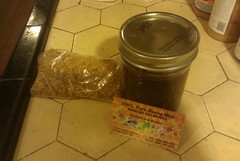
Their honey in comparable to store bought honey in prices but it definitely tastes GREAT, it is VERY Rich and much tastier than Cal Poly's farm store honey. This jar of honey was purchased for 7 dollars. I think it's somewhere between 20 and 25 Fl oz's.

The owners of this bee farm are Rodolfo and Martha. I spoke briefly with them and they have for boxes of bees. The darker honey is from various trees such as avocado and the lighter honey is from clovers and wildflowers.

I suggest going there. There are many health benefits to local honey and local bee pollen, particularly for allergies. And there's a benefit in knowing exactly where your food comes from. The next time I head out there to buy honey or pollen I'll ask them if I can have a tour of their bees and I'll see if I can post some pictures. Support your local economy and buy some honey!

Saturday, December 19, 2009

Pomona Massacre of Dec. 11th 2009


On December 11th in the still of the night, masked bandits made their way into my yard and opened the door to my chicken coop.

Unfortunately I was partly at fault. It was the night that i did not make sure the coop door had latched.

When I woke up in the morning I found that only one of my fifteen chickens and ducks were left alive. It was the sole rooster.

Raccoons massacred all but one of my birds overnight.

Raccoons are jerks. Let me tell you why; they did not eat most of the birds, in fact only one and a half were actually eaten. most of the rest were just killed, many of them with their heads severed.

I have already set a preliminary fence around the coop so that it will be harder for the raccoons to get to them and so that I can let my dog out to protect the birds. (i've successfully gotten our dog Nova to stop chasing chickens thanks to a dog whisperer episode) I will also be setting some humane traps for these bastards and will be sending them to the mountains.

Let this be a lesson, if there are critters in your yard call vector control services and also if you've got birds, keep them safe at night!


p.s. i would share pictures but it's pretty disturbing.

Tuesday, June 30, 2009

Forgotten Fruits: Mangosteen (Garcinia mangostana)


Ah, the mangosteen, the sweet sweet mangosteen (no relation to the mango). The Queen of fruits. This fruit is described as sweet and tangy, citrusy with peach flavor and texture. I've had it (canned), it's pretty delicious and definitely different. You can obtain canned mangosteen at many asian supermarkets nearby. It may even be possible to find fresh mangosteen in some asian markets but i've never seen it. In New York fresh fruits have gone for $45 a pound in some produce stores. It is very rare to find fresh mangosteen. So if you can ever get your hands on it, try it!.

Until recently it was completely unavailable in the States. It is a very tropical fruit and there were many restrictions on fruit imports from southeast asia where the mangosteen is native to. In 2006 Puerto Rico began sending mangosteen to some specialty food places in the US and in 2007 the ban on fruits without special preparation was removed allowing mangosteen and all its forms to be allowed into the states.

There is a legend that says that Queen Victoria had offered a reward to anyone that could bring the fruit back to her as the fruit itself had many legends behind it.

Because it is ultra tropical, it is nearly impossible to grow in the states. In it's native home, the tree can grow from 25 to 80 feet tall. What can be done though is to grow it in a greenhouse in Southern California. The mangosteen will surely die if it even spends a single night anywhere below 40 degrees F. Here in Pomona it's common to see nights down in the 30's in the winter. But with a green house some good design using passive radiant heating techniques could probably solve this problem.

There are also other types of mangosteen. The most popular is the purple mangosteen but there is also the lemon mangosteen, which is more citrusy in flavor and almost looks like a lemon (it's yellow) and also the button mangosteen. The lemon mangosteen is from South America instead of from asia and is described as a lemony cotton candy. The button mangosteen is described as having an almost tangerine like flavor. There are actually more types of mangosteens but it's hard to find much information on them. These two mangosteens can survive in temperatures down to 35 degrees, so i'll grow them in containers and at nights i'll bring them inside in the winter.

I have very young plants of both the lemon mangosteen and button mangosteen. I'm being very careful with these two as I've already accidently killed my jackfruit due to over watering. The button mangosteen is doing well, but the lemon mangosteen is going much slower, and I accidently burned part of one leaf. I'll need to make a small greenhouse out of the plastic bottles i've been collecting.

Friday, June 5, 2009

Forgotten Fruits: Goji Berry (Wolfberry)


This berry isn't totally forgotten, it has recently found a new following in health circles, but it is still unavailable as a fresh fruit. It is sometimes labeled as the Himalayan or Nepal Goji Berry to some exoticism to the berry but it is most likely actually just from China, like Citrus.

The botanical name is Lycium barbarum. As you can see, the "Lycium" is indicative of the name "Wolfberry" However it is probably a misunderstanding. (Lycos is latin for wolf but lycii and goji are Chinese terms)

It's gain in popularity is due to its high level of antioxidants. It is labeled as a superfruit like the acai berry (but note that oranges and strawberries are also "superfruits"). They are available in stores such as whole foods and asian markets as dried fruits. They have consistencies like that of raisins. Here in the States people will eat them by themselves or mixed in foods akin to foods with raisins or dried cranberries. Most Goji berries are grown in the Ningxia Hui region of north central China. In August there are Goji berry festivals that coincide with the harvesting of the fruits.

In China they are typically cooked usually in soups. In fact Lisa often makes soup with Goji Berries as an ingredient. These soups are generally used as tonics and are supposed to make you healthier.

They aren't readily available fresh because they are not shipped well. Only in regions where they are grown can one find them fresh at a store or farmer's market.

You can actually find the plants for sale. I recently purchased one and I will probably get fruits some time next year. The plants are used for erosion control in semiarid regions of China and are also being used to reverse the effects of desertification.

When I get my first harvest of Goji Berries I would be more than happy to do some trading with my fellow victory gardeners.

Oh, and the first time I had ever heard of the term Goji berries was from the first video made of the fellow below. (this is the second video made of him but you can see some of the exotification of the fruit however false it may be.) I had always known them as Wolfberries before.

Wednesday, May 27, 2009

Tomato Tasting at The Garden Nursery, Aug. (date unconfirmed)

Dawn over at The Garden Nursery on Holt will be hosting a tomato tasting event at her nursery sometimes in August. Lisa is a big fan of her nursery and we purchased a couple of tomato plants from Dawn earlier this spring.

Unfortunately I will be in Peru at that time but Lisa will be going to the event (she says she's going to help out at 7am, but I doubt she'll wake up in time, she's a night owl.) The event begins at 10:00 am and ends at 2:00 pm. She is expecting around 99 varieties of tomatoes. I wish I could go, but what I'll do instead while I'm in Peru, I'll try to sample as many Potatoes as possible (I'll even try to beat 99 varieties).

Also my dear friend Olympia who now works there should be there. She's the infamous Goddess of Garey Ave.

The best tomatoes will be voted on and you could win a prize. So remove that lawn, plant some food and bring your best Big Boys.

For more information on the event click here

Monday, May 25, 2009

Forgotten Fruits: Nungu Fruit, Borassus flabellifer


(yes I've changed it from Lost to Forgotten)

The British call it Ice-Apple, in Southeast Asia it has names that cary from Nungu to Tal. The palm itself is called different names from the Asian Palmyra, to Sugar Palm and also Toddy Palm (the last two for it's sugary sap)

The unpopularity of this fruit probably has more to do with sociocultural reasons than it does with shipping. Because this palm is a tropical palm from Southeast Asia, it was probably difficult to grow in Europe, so it never made it to the Americas. Most fruits available in supermarkets are generally from East Asia, Europe, the Middle East and the Americas. This one is from Southeast Asia, (Thailand, Cambodia, Vietnam and the south east tip of India) and surrounding regions. Because those countries are not major world powers influence in new fruits is relatively slow in America.

The palm can get up to 100' high (like the Mexican Fan Palms that are common in southern California). It is the official Tree of Tamil Nandu (a state in southeast India) and is the palm most associated with the Angkor Temple in Cambodia. It could be a great replacement for the MFP's that line the streets of Garey Ave. in south Pomona. (it only makes sense, considering what "Pomona" means)

This description is from Wikipedia "The fruit measures 4 to 7 inches in diameter, has a black husk, and is borne in clusters. The top portion of the fruit must be cut off to reveal the three sweet jelly seed sockets, translucent pale-white, similar to that of the lychee but the flavor is milder and there is no pit. The jelly part of the fruit is covered with a thin yellowish brown skin."

The tree itself also contains a sap known as Toddy, it is sometimes used to make sugars and fermented drinks. This is also one of the few genii of palms that are actually used for timber.

I found a Nursery in San Diego called J.D. Anderson Nursery that lists it as a palm that they sometimes carry, they are however out of stock. I haven't called them yet to see when they might get some more, but when school gets out I'll be doing more nursery visits to find some more forgotten fruits.

Wednesday, May 20, 2009

New Urbanism vs. Landscape Urbanism

A reader asked what my bias is between these two schools of thought in regards to city design. Simply put, I find both of them useful but both of them also do not answer certain concerns about life in the city. I'll also discuss New Pedestrianism.

New Pedestrianism and New Urbanism both tend to focus on the walkability of the town or development. They tend to keep parking lots away from the streets instead making buildings and building entrances on the street. Walking to the center of town would take 5 minutes or less(in which there is usually a transit station) and all children should be within walking distance of schools. New Pedestrianism goes further to almost entirely abolish automobiles based on the way cities are designed. Allowing for more walking bicycling and public transportation. Both schools of thought exemplify mixed use and mixed housing types allowing for young people, older people and families to all cohabit with each other.

This allows people to remain in their town. With everything being walkable, money remains in the city, more jobs are placed in the city and pollution is reduced (as cars are gross polluters)

For those things, New Urbanism and New Pedestrianism is powerful and works. Downtown Pomona seems to be on the path of New Urbanist values. It isn't quite there yet especially with the large parking lots, and a lack of investors but it's definitely on it's way and I think it's great. A lack of investors is a blessing in disguise. it keeps investors that come into downtown coming FROM locals. Chains and corporations would suck the life and charm out of the city. For this I think the DPOA can be powerful as well.

View Untitled in a larger map
If you look at the map you can see the tight grids and the downtown is in the center of the city which is good. the transit system is however a tad weak and along major arteries such as Garey and Holt parking lots are in the way and there aren't many businesses that I can personally use.

Landscape Urbanism seems to be a bit more theoretical. It is a much newer school of thought and accepts suburban has and is happened and may be difficult to alter. This school of thought focuses more on landscape as organizing a city rather than buildings. Adaptability and change are utilized and expected and instead of a city being static it is understood to be dynamic and ever changing. The city becomes a series of of adaptable systems rather than a series of structures.

What this does, is it allows for ecological habitation. If the landscape organizes the city instead of buildings, the landscape is exemplified. The landscape can then provide for ecological habitats and green space. Phillips Ranch is the closest to this in Pomona but it is not nearly to the scale it should be, but even more so but on much smaller scale the Lyle center for Regenerative Studies at Cal Poly. The Lyle Center is designed according to the forms of the landscape, keeps space open and provides space for ecological habitats. Phillips Ranch provides a fairly long greenway, though somewhat narrow, it is the ravine for the Phillips Ranch area to carry water away. It is also however mostly lawn and the plant palette had very little variety.

View Untitled in a larger map
So while New Urbanism and New Pedestrianism provides great solutions for walkability of cities reducing dependence on automobiles and keeping money circulating. That's all it really does.

Landscape Urbanism provides opportunities for change in situations as big as global warming and as small as wildflowers in a park.

One of the most important things that they both don't do is to solve problems with food. Food has not been self contained for a long time. Food grown in public spaces like the Lyle Center and around the Regen Co-ops becomes a problem because it is often harvested prematurely and not shared publicly. It is fine do so and grow food publicly, but one cannot depend on it.

I think a hybrid of New Urbanism and New Pedestrianism with Landscape Urbanism could provide the adaptability needed for cities and ecological habitat (food can even be planted in the public spaces) and reduce dependence on driving as well.

What is missing is private food production. One cannot grow their own food in a highly densified city without land. Vertical green walls could work, but try growing a fruit tree on a wall.

I think a solution could be placing a large center like Downtown Pomona in the middle of the city, with major arteries like Garey, Towne, White and Mission & Holt should be lined with mixed use retail, living, dining and office space (with no parking lots!). Each Corner of the city (NE, NW, SW & SE) should also have smaller centers. The landscape could demarcate where "green" corridors could be placed. IF the land is entirely flat like Chino and In the Midwest, Diagonal axes of large greenbelts could be created going from the NorthEast corner to the SouthWest corner and the SouthEast corner to the NorthWest. Since that diagonal is the longest it would take to walk, a large park that can be walked through to get to the center of the city could be helpful. Yards can remain large for food growth and as residences get closer to city centers they can become smaller and smaller, that would provide different types of housing for a variety of people. That could be the most basic infrastructural framework and nuances could be developed as needed. I don't know that's just my thought. Phillips Ranch could be great if there were more retail space(minus the parking in front), dining and variety of housing types. The retail could be on the opposite of the long phillips ranch park all along village loop and it'd be perfect. (forget the fact that the house designs are basic tracts and have no character that reflect the landscape and the region.)

I wonder if this comes off as a rant but anyone with ideas and input is ALWAYS welcome. I've just grown more and more concerned with the problem of growing food and I see that as a problem with the existing popular schools' of thought.

Wednesday, May 13, 2009

Forgotten Fruits: The Thimbleberry


This one isn't so lost as it is uncommon. The Thimbleberry is another one of those fruits that no one eats because it cannot be found in the market. The reason this isn't grown commercially (as with most unavailable fruits) is that it does not ship well. When ripe it is softer than a raspberry but also larger.

As with the Raspberry and Blackberry the Thimbleberry is part of the Rubus genus. In fact there are hundreds if not thousands of plants in the Rubus genus and most of them have edible berries.

This Rubus, the Rubus parviflora is unique to most others in that it has NO THORNS! It is native to North America mostly in northern and western regions so it probably isn't as hard to find. The leaves resemble maple leaves which is different from the blackberry. It grows more similarly to the raspberry than the blackberry, which, means that it is more upright than bramble-like.

This shrub isn't as hard to find as the medlar tree, It can be ordered from most Northwestern native nurseries

Thursday, April 30, 2009

Forgotten Fruits: The Medlar Tree

I'm going to make this a new part of my blog. So we'll see how it works.

Here's an introduction:
Think about all the food you eat. EVERYTHING you purchase at the supermarket has ONE thing in common. If you ONLY eat food from supermarkets and food from restaurants that means EVERYTHING you eat has this same thing in common. Give up?

All that food is profitable. All that food you eat is grown, or sold, most likely because it can be shipped. Think about figs, only recently have fresh figs been available in the market because of new breeds. Figs were only available as dry fruits (see: fig newtons) and that is really the only thing that saved the fig from being lost in oblivion. Figs typically open up on the ends when ripe and so they were never suitable for shipping. The tomatoes one buys at markets are also tough skinned so they won't bruise or break when being shipped. And so our diets are based on what foods are profitable for business. (see: McDonalds)

Unfortunately this has happened to many fruits. And today I'm going to talk about the medlar fruit.


I've never had one, but i've heard good things. It is native to Iran and was grown in ancient Rome and Greece. This leads me to believe it may be a PERFECT tree to grow in southern California as we share the mediterranean climate it was originally grown in. Mespilus germanica is it's botanical name. The fruit needs to be bletted in order to be eaten (that means it needs to be over ripe like the persimmon) It is also similar to the persimmon and blueberry in that the flower is directly attached to the fruit and noticeable. The fruit is a matte brown when ready to eat and is described as similar in taste and consistency to apple sauce.

Here is a photo of some of it's flowers. The tree gets to about 25 feet or so and is deciduous. "medlar" was once used as a term for "whore." And Mercutio mentioned the tree in this context in Romeo and Juliet.

"If love be blind, love cannot hit the mark.(35)
Now will he sit under a medlar tree
And wish his mistress were that kind of fruit
As maids call medlars when they laugh alone.
O, Romeo, that she were, O that she were
An open et cetera, thou a pop'rin pear!(40)
Romeo, good night. I'll to my truckle-bed;
This field-bed is too cold for me to sleep.
Come, shall we go?"

I would LOVE to get my hands on a tree, but I can't seem to find a local nursery that has them for sale. I did find this nursery in northern california that I could order one from but they seem to be out of stock. Rolling River Nursery

If anyone knows where I can find one TELL ME. If I can find a place that sells them I'll share it here. And if anyone has ever had one fresh, please share your experience! Otherwise I'll keep checking back on Rolling River Nursery until I can get one of my own.

Friday, April 10, 2009

Live Chickens in Pomona


Little chicken
Originally uploaded by hddod
The other day (before my bicycle got stolen) I found a chicken walking around my yard. It had actually been walking around quite often in my yard and figured it was a neighbors coming to hang out. I'm fairly busy so I don't go out in my jungle that often.
But the other day I decided to chase it around. It had three chicks following it and I wanted to see where it'd go. As it turns out, this chicken and her chicks have been LIVING in my yard without my knowledge! I chased it to its nest which is hidden behind a few stalks of bamboo where our fence meets the shed. Very hidden and discreet. I found a lot of broken egg shells and feathers in the nest.

I decided I'd have to take the chicken to court and file a civil suit. But, I figured it could wait until the morning. Later that night, I heard the chicken get in a fight with a cat, twice. I went out to see what was going on but I was too late each time. Come morning, there was only one chick left. Poor chickens. So, while the chicken was out grazing for some food, I blocked off her nest and then cornered the chicken into our cage(it was formerly a wild cat cage) and then locked her up.

So with this, I've been looking at chicken laws in Pomona. Calwatch had given out some information previously but I wanted to know more. Pomona Muni Codes see Chapter 6

Chickens ARE legal to keep in Pomona BUT Roosters are not. There are at least two roosters in the neighborhood, one of them frequently visits (probably the father of the chicks).

I am a little confused about about 6.9 since the chicken had been obviously living at my house. Do I need to actually go to the shelter manager and then see if I can own the chicken?

Animals that aren't allowed within city limits are Swine, Dangerous or Poisonous Reptiles, Bees, Male Goats, (and exotic animals without a permit)

Unfortunately the only animals that one is allowed to slaughter are Chickens and Rabbits, (I would like to raise ducks but I won't be able to legally slaughter them within city limits, however I just might accidently do it anyways)

So, I suggest more peole raise chickens in Pomona, Maybe we can all help feed each other. And you don't need a rooster to get eggs, just eggs that turn into chicks.

Friday, April 3, 2009

Too many workshops on April 4th!


Don't forget everyone, My good friends at the Regen Cooperative of Pomona is putting on the 6th annual Sustainability Seminar beginning at 8am at 341 Kingsley Ave. Pomona

More info and Schedule can be found here


Also there is an Old Home Restoration Workshop put on by Pomona Heritage at 9:00am at the Trinity Methodist Church at 676 Gibbs, near Holt

More info here

and ONE more!!

According to Lisa, The Garden (nursery) at 845 N. Garey Ave. is doing a Victory Garden workshop at 2:00pm

Here's a website but not much info

so much to do, so little time! Maybe next year our good community organizers can get together and try to do things on different weekends! wouldn't it be great to have different things to go to every weekend?

Did I mention EVERYTHING IS FREE!?

Tuesday, March 31, 2009

Spring is Here, Don't Forget to Save Your Seeds!


Water lotus seed pod
Originally uploaded by petrichor
All you Pomoniacs out there, as you're planting your vegetables and harvesting fruit and what not, DON'T FORGET to SAVE YOUR SEEDS!

It'd be really nice if we could have a vegetable seed exchange at the end of the Summer and again at the end of Winter.

That way resources won't be spent on shipping seeds around the country. We can just trade.

Also don't forget to share your fruits and vegetables with your neighbors. I've got a bunch of All Reds Potatoes growing I'd love to trade with some others. (I've even got some Lemon Tree seedlings I'm willing to trade)

I will be glad to organize such an event.

Thursday, March 19, 2009

SAVE THE DATE: APRIL 4th! (FREE event in Pomona)


Come one come ALL to the Sustainability Seminar in Pomona at 341 Kingsley Ave. on April 4th FREE

Here's a schedule of Events (it's hard to read so just click on the link above.)


I'll definitely be attending the beginners beekeeping, edible mushroom cultivation and transition towns

I hope to see many of the other bloggers there and other community members. You'll get to meet some interesting some eccentric and just some plain old normal members of the community that have some skills and ideas to share.

Tuesday, March 17, 2009

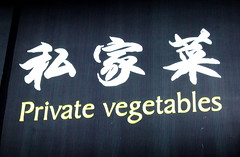
Private Vegetables


Private vegetables
Originally uploaded by xiaming
When I talk about major changes is a result of our global economy and global warming what I'm actually talking about is the change in our daily lives.

And this is what I'm talking about most. "Ten Winners in the Recession - #1"

While we are used to having a supermarket around the corner, it is only a matter of time until most people on the street are growing their own vegetables and even their own meats.

Our neighbors have chickens and a pair of roosters that sometimes escape into our yard. Does anyone remember victory gardens? Growing your own vegetables is fun, it's easy and it's only a tiny piece of what is coming to be known as urban homesteading. Instead of buying complete products at the market we can do the processes ourselves.

We would no longer have food that is grown for its ability to ship well, we'll have food grown for the quality of the taste and nutrition. (remember quality over quantity?) That can only happen with homegrown food.

It's just unfortunate that some cities don't even allow chickens. You can own a dog that barks all night (not to mention it might kill a baby) but a chicken that clicks and gives you food is illegal? Laws like that NEED to change.

It doesn't stop at vegetables and chickens. it goes beyond that. Try brewing your own beer. Try mending your own clothes. Instead of flushing all that water out of your washing machine, use a safe cleaner and reuse that water to water your garden. Why not? it's such a waste and you'll save a couple of bucks.

If you don't know where to start, the folks at the Homegrown Evolution blog can help you out, they even have a book out called "The Urban Homestead" which I had mentioned in a previous post

If there's one thing I am more than an environmentalist it's that I'm cheap(though that may be a result of circumstances). If it doesn't save me money I probably won't do it. That's why I only hit Trader Joe's and the like when there are sales. (It's a different story for specialty shops because they ARE cheap).

So get some private vegetables and share your seeds and chicken eggs.

Wednesday, November 12, 2008

Time Banking & The Urban Homestead

Last night I made it out to Los Angeles, to
Materials & Applications
. They put on a workshop for Time Banking by the Echo Park Time Bank and short presentation by a co-author of "The Urban Homestead"

"M&A is a research center dedicated to pushing new and underused ideas for art, landscape and architecture into view." I'll show some photos of the place later on.

Time Banking is a very interesting concept developed by Edgar Cahn. Lisa Gerstein and Autumn Rooney explained to us the system of trade based on time. What you do is you work for someone for an hour and then you've earned a one hour time dollar which can be spent on having someone do something else for you! One issue of concern brought up was that some people may consider their time more valuable based on the work you do. Well, get over it! An hour is an hour. How many times have you helped a friend based on your expertise? Well that friend probably owes you a couple of dog walks, and with a time bank you can "purchase" an hour from anyone involved in the community! This system is not the same as bartering. The terminology is actually tax exempt, even the goods trading is tax exempt, but that trade is based on the honor system.

I think this form of exchange of services can be very useful, I wonder if it would work in Pomona. There is software to keep this all in order available from timebanks.org In fact if we had a time bank in Pomona I would offer my Landscape and Environmental Expertise in time dollars.


Shortly afterways Erik Knutzen
spoke to us about his book that he co-authored with his wife Urban Homestead

It's a great book (I haven't read it completely yet) about self sufficiency in the urban arena, It includes not just home gardening but also how to cook with passive solar energy, how to store food for the long haul, and also many other eco-friendly and cost effective ways to sustain oneself.

I had the chance to speak with Erik and he's a really nice guy, I asked him if he would speak at my school about his book at one of our community dinners. He said he has been meaning to come out and visit the Regenerative Studies Center, and well, this would be a good opportunity to kill two birds with one stone. I will keep ya'll posted as the events unfurl.

And about M&A there is an installation in the front called Yakuza Lou, I took some shots of the robotic ephemeral landform.


And a Cloud

Wednesday, October 15, 2008

Building a Cob Oven: Cobbie The Cob Oven

Today I just finished (well almost) our cob oven at work/school at the Regenerative Studies Center at Cal Poly. I built most of it with Justin and Jill, my coworkers, we named it Cobbie (don't ask). We built it on our outdoor Barbecue next to our Bocce ball court.

A cob oven is a wood fired oven made of Earthen Clay and Sand as well as Hay (or sun dried manure, we used hay). Our cob oven is "sustainable" since we used clay from on site and the rest of the materials we used are not necessarily renewable or regenerative but abundant and thus "sustainable"

What we did first was lay out some bricks for the oven to be on top of and then Mound up some wet sand into a Half Sphere on top of the bricks. We covered the wet sand with plastic and then began the main process.

We mixed clay and sand together 2 parts clay and one part sand.

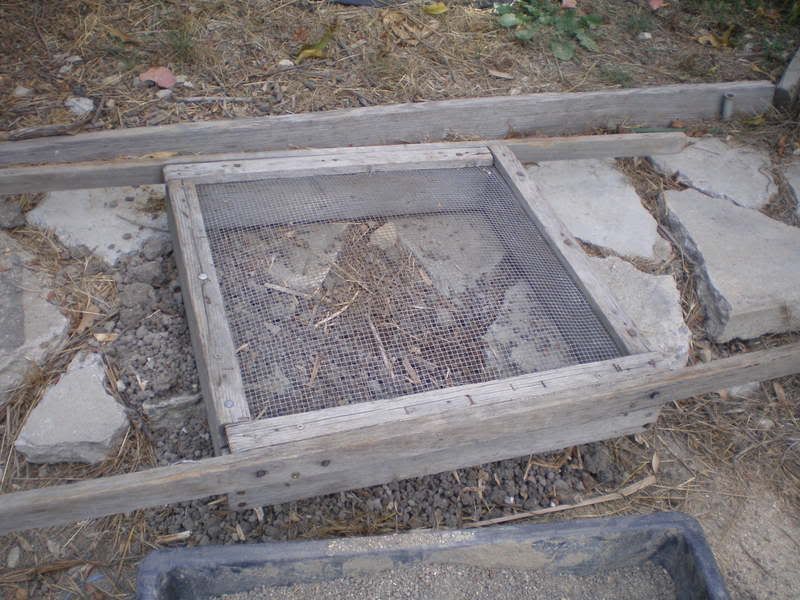
A sifter is used for the clay to make sure we don't get any rocks into the mix.

The clay acts as a cement, when clay drys it hardens and like mixing cement the sand helps to aggregate it.

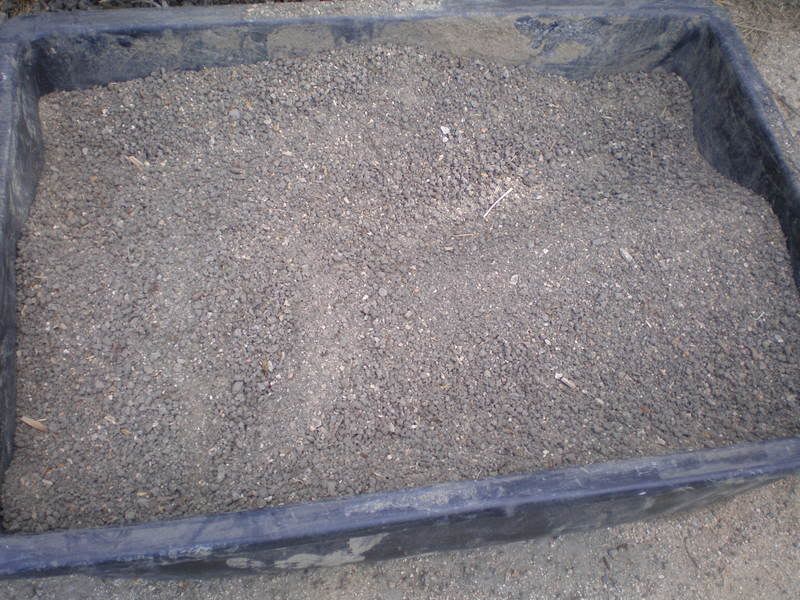
The next day we mixed sand, clay and small pieces of hay. The reason for the hay is for the fibers, the fibers hold the mixture together stronger.
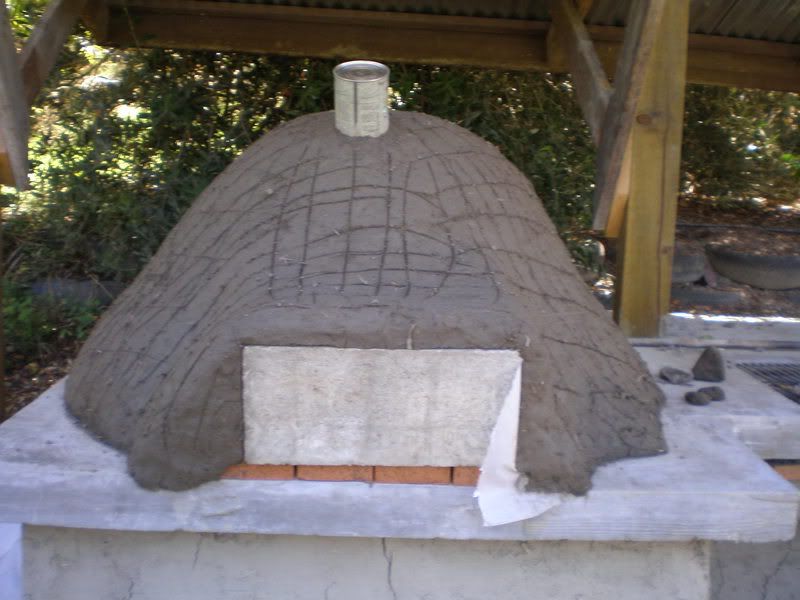
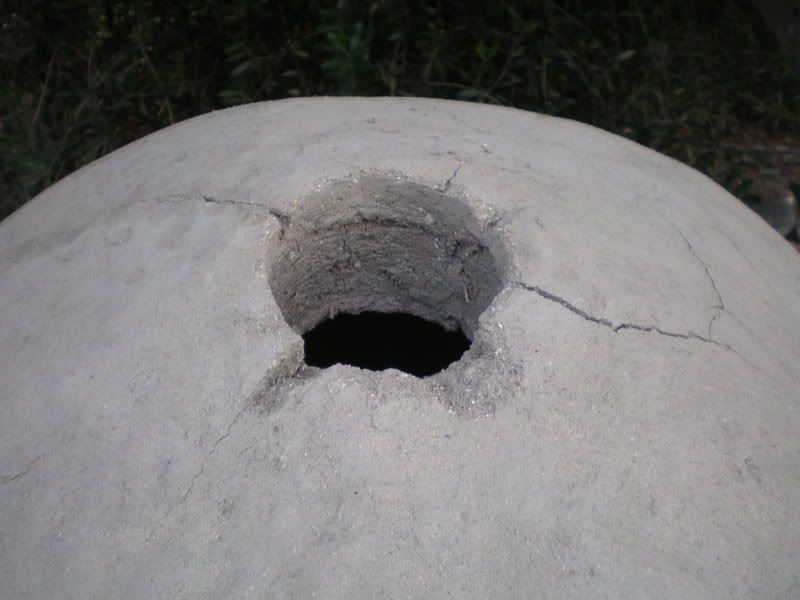
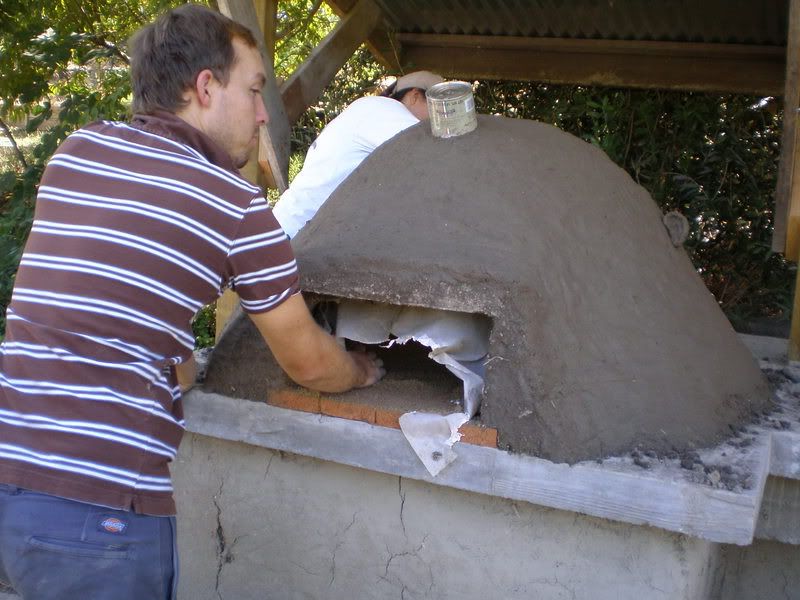
The cement brick will serve as a door. The bricks on the bottom were used because bricks retain heat and help keep the oven hot. We also used a Coffee can as the hole for our chimney (that's the only part that isn't finished yet.)

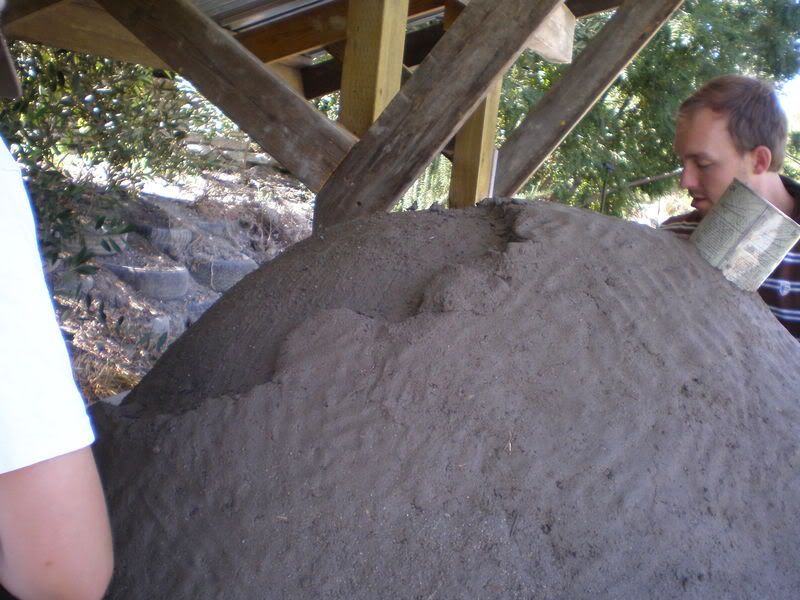
You can see how thick the layers are. The first and last layers are thinner than the middle layer, this mixture is typically 3 parts sand and 1 part clay. Here are Jill and Justin hard at work.

When we were done with the last layer and the oven began to dry we removed all the sand from inside.

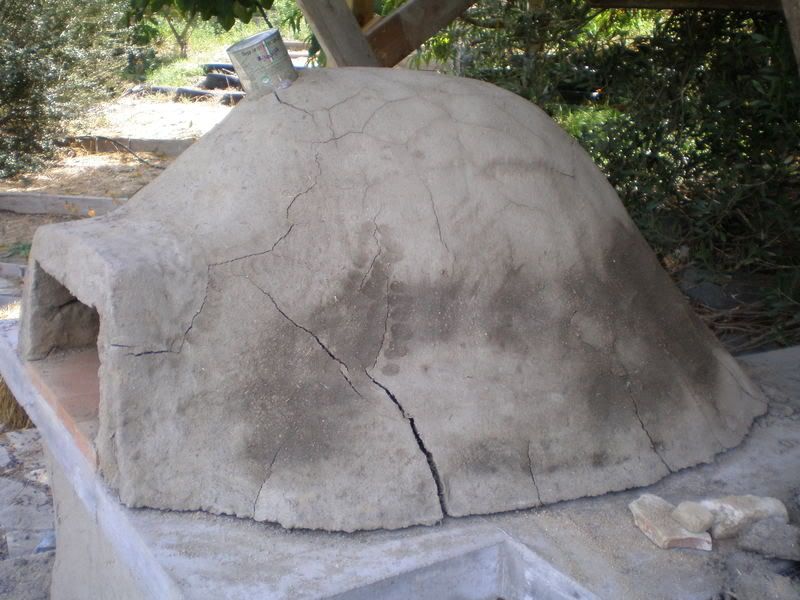
But alas! as the oven dries it begins to develop wide cracks, the cracks only go as deep as the layer the cracks occur on (hence one of the reasons for the three layers).

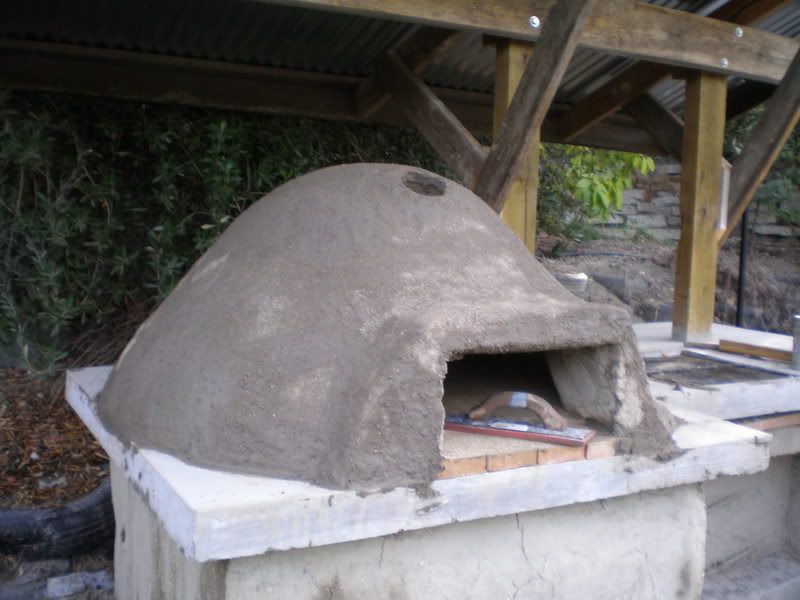
Now that it is fully dried it is a much lighter color and the cracks have finished developing. We also removed the coffee can so we can soon add the chimney. If you notice on the bottom of the oven where it meets the counter the oven is no longer touching the counter. When the cob mixture dries it shrinks, that causes the cracking and also the lifting, The large cracks are about a half inch thick and the bottom of the oven is about a half an inch off the counter now. (it's not floating it's all resting on the bricks, but that's obvious right?)

With the cob oven all dried I made a final mixture of clay and sand to the consistency of a wet plaster, (much like the final layer) and filled in the cracks. This trowel that I'm using is a sponge trowel used to smooth out the final texture of the plaster.

All that remains is the chimney (this photo is before I fixed all the cracks). You can see how thick it is in its thinnest area. If you look carefully you can see the middle layer with pieces of hay.

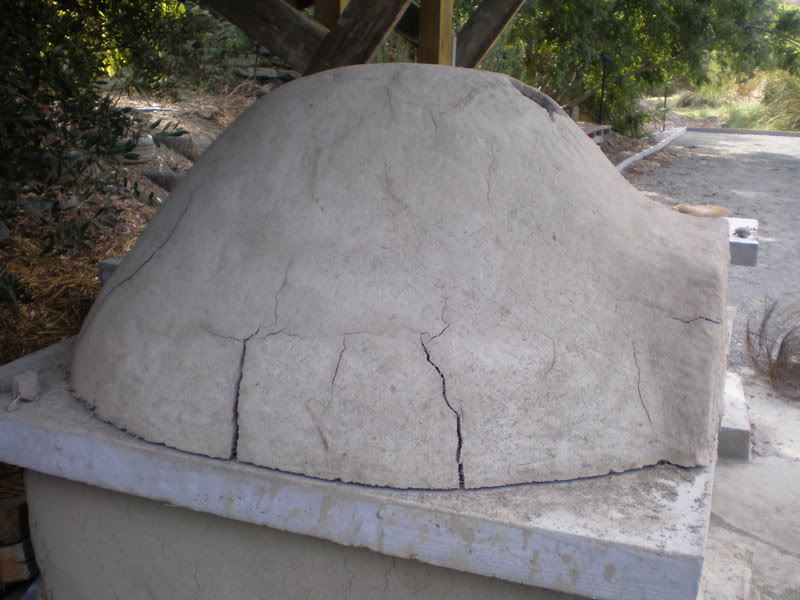
Here's the near final product. Once it is dry and the chimney is put in we'll fire it up to harden everything even more even though it's already as hard as a rock. Take note of how thick it is in some parts near the brick on the bottom, also note the roof above it, cob ovens shouldn't get wet unless it has a lime coat on it, we don't need one so we won't put one.

I can't wait to cook some pizza in it. Winco in Pomona near Phillips Ranch has some pizza dough in a ball near their dairy section. All of those in Pomona come to the Regenerative Studies Center at Cal Poly and check out our handy work.

Wednesday, October 1, 2008

Fighting the Enemy: Ants


Ant
Originally uploaded by sbfisher
At work and at home we have ants. Argentine ants. a LOT of them. THEY BITE!
I despise these little critters. Some days when I work I'll pick something up and within seconds I'll be COVERED in ants.
At home I left some meat out on the counter and went to the bathroom, when i came back the plate was crawling with ants. I couldn't even see the meat anymore it was a blanket of Argentine ants.
The worst day was when I woke up in the middle of the night and I was covered in ants, ants all over my sheets. I couldn't find where they were coming from!

I found an Organic and Safe solution to those out there battling ants like me in Pomona. Though In the kitchen I had to seal the holes where they were coming in with latex sealants. This may not work in the bathroom where the window is almost always open. I don't want to seal my window up! So what I did was use Cayenne pepper powder. It won't kill the ants but the ants don't like it at all. Within an hour the ants were all gone. Ants hate any spicy powder, so Garlic powder, Cayenne Pepper powder, Chili Powder, anything spicy. You may have to use a bit though, create a thick layer of the stuff. After a few days the powder will settle and the ants will just make a trail over it. All you have to do is disturb the powder every once in a while to keep the ants out. You could create a perimeter around wherever you want to keep ants out of.

I hope I never wake up covered in ants again. I'm going to sleep with a bottle of Cayenne Pepper powder next to me from now on.

Sunday, May 4, 2008

Farming is tough


Today i learned how to use one of these. it's GENIUS I've never used one but it's so simple. Apparently it's a common agricultural tool. A little bit about how it works.
With freshly tilled loose soil, the front wheel helps separate the soil. The metal piece on the bottom in the middle has adjustable lengths to create a hole for the seeds. A gear on the inside of the red bucket intermittently allows seeds to drop through the metal piece in the middle. A chain follows that piece which pulls dirt over the seeds and following that is a flat wheel in back to help compact the soil. One just needs to be aware of jams in the gear. This is my first time using this and I am now fascinated with agricultural tools.
I've also got a new found appreciation of farm workers, after four hours of weeding my back begins to hurt immensely, it is NOT easy work.

I also learned how to braid garlic at the Center. It's very similar to french braiding, I guess it is french braiding just done upside down. I braided a set of 15 heads for my girlfriend and when I brought it home just she asked if we had a vampire problem. So for kicks I placed the braid on the door. The smell is much stronger but also sweeter than store bought garlic. Organic, locally grown and freshly picked is always the best.
So for all you garlic fans, come by the center QUICK and pick up your braids of garlic for free, they'll run out fast, i guarantee it, They were just picked today (technically yesterday, Saturday) and you just might get one braided by either myself, or the Goddess of Garey Ave.