
So my blog has basically been defunct for some time. But here is a link to an article about what I've been up to.
In the meantime I'v contributed to M-M-M-My Pomona once or twice
Thursday, December 9, 2010


Saturday, March 6, 2010
Home Buying
I'm trying to buy a home in lovely Pomona. I put in an offer for one and I really hope I get it. Even though the house has been on the market for a few months i made a really low offer because it needs work and i've seen vandals walk out of the property. Send good vibes or prayers, whichever it is that you do. I'm remaining reservedly hopeful.
Why didn't anyone tell me that home buying is so stressful?
Why didn't anyone tell me that home buying is so stressful?
Saturday, February 20, 2010
Congratulations Juan and Susie!
When I first moved to Pomona I didn't know a SINGLE person living in the area. So I asked a friend in Santa Ana (who i knew knew people in Pomona) who i could talk to so I wouldn't feel like a stranger. She (Teresita) told me about Susie, Juan and Bunny Gunner. It took me a while to ever approach them because well, what was I gonna say? "Hi I'm new, will you be my friend?" Well, it turns out, I probably could have done that and they would have been my friends!
What happened instead is, I started blogging and I started following their blog as well, Pomona's Art Colonists and I began to get the feeling that they were warm and welcoming people whose doors seemed to always be open to people in the community. We slowly became virtual buddies by reading each others blogs and eventually i decided to pop my head into the shop in the middle of the day on a weekday. So I rode my bike over there and finally got to meet them face to face. They were the kindest people and they welcomed me to the community with open arms! I incidentally got to meet REN for the first time during my visit. Although I spend most of my time locked away studying, when I do go out and I see Juan and Susie it always makes my day because they are both such genuinely good people. I thank Juan and Susie for welcoming me to this tight knit community, I never once felt like a stranger and i love them dearly for their kindness.
Congratulations Susie and Juan! I wish you both the best from the bottom of my heart!
What happened instead is, I started blogging and I started following their blog as well, Pomona's Art Colonists and I began to get the feeling that they were warm and welcoming people whose doors seemed to always be open to people in the community. We slowly became virtual buddies by reading each others blogs and eventually i decided to pop my head into the shop in the middle of the day on a weekday. So I rode my bike over there and finally got to meet them face to face. They were the kindest people and they welcomed me to the community with open arms! I incidentally got to meet REN for the first time during my visit. Although I spend most of my time locked away studying, when I do go out and I see Juan and Susie it always makes my day because they are both such genuinely good people. I thank Juan and Susie for welcoming me to this tight knit community, I never once felt like a stranger and i love them dearly for their kindness.
Congratulations Susie and Juan! I wish you both the best from the bottom of my heart!
Wednesday, January 20, 2010
Forgotten Fruits: Cashew Apple
So, it's the return of the forgotten fruits topic. Today I'm going to talk about the Cashew apple (or marañón). There is a lot to discuss when talking about the Cashew apple and it has a lot of implications as a fruit.
As you could have guessed the Cashew nut and the Cashew apple are from the same tree, and as you can see, the nut actually grows from the end of the fruit (making the cashew apple a pseudo fruit).
You may be wondering why the cashew nut is so prevalent yet the fruit is nowhere to be found anywhere! Because this is a perfect example of a fruit that is unavailable to our markets because it cannot be shipped. The skin of the fruit is too fragile for shipping, so we won't see it in any markets anytime soon. "What about at a farmers market?" you ask. Well, it's a tropical tree that begins to decline at about 50 degrees F and will die if temperatures get close to freezing. Trust me, I tried growing a tree once and it didn't even have a chance. Until I get a large greenhouse, I won't be trying it again.
There are also a lot of arguments against shipping foods overseas, however shipping via boat is actually super-efficient and more greenhouse gases and emissions are emitted from delivery trucks going short distances. So really the best solution is to grow your own food in terms of shipping emissions concerns.1
The fruit is described as very juicy and sweet and juice made from the fruit is fairly popular in Brazil. I suppose the juice could be shipped and sold here, but introducing new foods to existing markets is probably very hard. That is, until someone claims it as a "superfruit"
Source: 1 Weber, Christopher & Matthews, Scott (2008) Food-Miles and the Relative Climate Impacts of Food Choices in the United States, Environmental Science and Technology 42 (10)
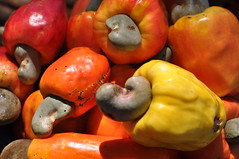
As you could have guessed the Cashew nut and the Cashew apple are from the same tree, and as you can see, the nut actually grows from the end of the fruit (making the cashew apple a pseudo fruit).
You may be wondering why the cashew nut is so prevalent yet the fruit is nowhere to be found anywhere! Because this is a perfect example of a fruit that is unavailable to our markets because it cannot be shipped. The skin of the fruit is too fragile for shipping, so we won't see it in any markets anytime soon. "What about at a farmers market?" you ask. Well, it's a tropical tree that begins to decline at about 50 degrees F and will die if temperatures get close to freezing. Trust me, I tried growing a tree once and it didn't even have a chance. Until I get a large greenhouse, I won't be trying it again.
There are also a lot of arguments against shipping foods overseas, however shipping via boat is actually super-efficient and more greenhouse gases and emissions are emitted from delivery trucks going short distances. So really the best solution is to grow your own food in terms of shipping emissions concerns.1
The fruit is described as very juicy and sweet and juice made from the fruit is fairly popular in Brazil. I suppose the juice could be shipped and sold here, but introducing new foods to existing markets is probably very hard. That is, until someone claims it as a "superfruit"
Source: 1 Weber, Christopher & Matthews, Scott (2008) Food-Miles and the Relative Climate Impacts of Food Choices in the United States, Environmental Science and Technology 42 (10)
Sunday, January 17, 2010
Uncertain Futures and Invested Interests
In a discussion in class recently, we touched on the idea of how people deal with time in relation to their living situation. It really hit home.
Here in Pomona, I've noticed from first hand experience that a lot of people who live here are renting either their apartment or their house. I for one am one of them.
This affects my invested interest not only in my home but also in my city. The uncertainty of my future in this particular home makes it so that I have very little interest in spending money to fix my home. Unfortunately, the house needs a lot of work. A new roof is needed (those who follow my blog will remember the loss of a laptop due to a leaky roof) but all that has been done is that plastic has been placed on top of the roof. I am not interested in paying for the new roof. Seeing as how I sublease, I am not in contact with the actual property owner so my line of communication is already complicated.
(Why not just move out? well, as a starving student who is trying to save money to buy a house I have very few options)
If I owned my home my futures have a higher level of certainty so my invested interest in the house would be increased. And the home that I might own, being in a certain city would also increase my invested interest because I am more likely to stay within that city because I live in the home that I own.
To be honest, I don't know how long I will be living in Pomona because I do not own a home here. Also, I do not know what home prices will look like when I have enough saved up to buy a home. Though homes are cheap in Pomona and I really want to stay, there is a chance that I may need to look elsewhere for a home.
SO, like most renters I have a greater likelihood of transience. Thus my invested interest in the city is not as high as it might be due to that. With so many homes "se rente," we wonder why, with a population so high, so many people don't show that they care in this wonderful city of Pomona.
We studied this in relation to environmental issues but it indeed relates to many other issues of concern inside a city.
There are other cities that require that when someone buys a house, they (or sometimes an immediate family member) must live in it for at least a year or more before they can consider renting it out. I'm just saying... it's something worth considering.
(The article of discussion was "Time, Cycles and Tempos in Social-ecological Research and Environmental Policy" by Charles H. Wood from Time & Society 2008; 17; 261)
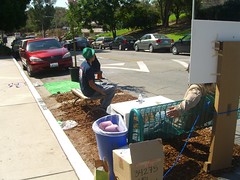
Here in Pomona, I've noticed from first hand experience that a lot of people who live here are renting either their apartment or their house. I for one am one of them.
This affects my invested interest not only in my home but also in my city. The uncertainty of my future in this particular home makes it so that I have very little interest in spending money to fix my home. Unfortunately, the house needs a lot of work. A new roof is needed (those who follow my blog will remember the loss of a laptop due to a leaky roof) but all that has been done is that plastic has been placed on top of the roof. I am not interested in paying for the new roof. Seeing as how I sublease, I am not in contact with the actual property owner so my line of communication is already complicated.
(Why not just move out? well, as a starving student who is trying to save money to buy a house I have very few options)
If I owned my home my futures have a higher level of certainty so my invested interest in the house would be increased. And the home that I might own, being in a certain city would also increase my invested interest because I am more likely to stay within that city because I live in the home that I own.
To be honest, I don't know how long I will be living in Pomona because I do not own a home here. Also, I do not know what home prices will look like when I have enough saved up to buy a home. Though homes are cheap in Pomona and I really want to stay, there is a chance that I may need to look elsewhere for a home.
SO, like most renters I have a greater likelihood of transience. Thus my invested interest in the city is not as high as it might be due to that. With so many homes "se rente," we wonder why, with a population so high, so many people don't show that they care in this wonderful city of Pomona.
We studied this in relation to environmental issues but it indeed relates to many other issues of concern inside a city.
There are other cities that require that when someone buys a house, they (or sometimes an immediate family member) must live in it for at least a year or more before they can consider renting it out. I'm just saying... it's something worth considering.
(The article of discussion was "Time, Cycles and Tempos in Social-ecological Research and Environmental Policy" by Charles H. Wood from Time & Society 2008; 17; 261)
Thursday, January 14, 2010
Pomona's FIRST Bike Lane!
Technically it's not the first but I don't think I can justify the roundabout bike lane at the Red Cross building as being of any use to the city since it is probably only used by Cal Poly Students who typically have no desire to be invested in the city.
BUT, Pomona finally has a bike lane! and here it is!
View Larger Map
I noticed it a few months back but never reported on it. Unfortunately, that bike lane is very much out of the way for me except when I ride to school. Also, the lane is less than a mile long. A bike lane down Garey would be great, but then we'd lose a lot of parking and street parking is way smarter in terms of walkability than having parking lots. UNLESS we have the bike/car lane hybrids like they have in Pasadena we may never see a bike lane along Garey. But, there are other streets closer to Garey that could fit bike lanes, such as Park and also Palomares. There are also a lot of east west streets that have room for bike lanes such as oh... I don't know, ALL the number streets, 1 through 12th, then grand, phillips, franklin, lexington, philadelphia, and olive.
In fact, until I see bike lanes on all those streets...
Well, I just hope it happens soon.
BUT, Pomona finally has a bike lane! and here it is!
View Larger Map
I noticed it a few months back but never reported on it. Unfortunately, that bike lane is very much out of the way for me except when I ride to school. Also, the lane is less than a mile long. A bike lane down Garey would be great, but then we'd lose a lot of parking and street parking is way smarter in terms of walkability than having parking lots. UNLESS we have the bike/car lane hybrids like they have in Pasadena we may never see a bike lane along Garey. But, there are other streets closer to Garey that could fit bike lanes, such as Park and also Palomares. There are also a lot of east west streets that have room for bike lanes such as oh... I don't know, ALL the number streets, 1 through 12th, then grand, phillips, franklin, lexington, philadelphia, and olive.
In fact, until I see bike lanes on all those streets...
Well, I just hope it happens soon.
Tuesday, January 12, 2010
Journey to Peru + Water
I recently guest "blogged" on Green Empowerment's blog about my experience with them in Peru.
There was the link and here is the nearly identical post.
In August myself and some classmates headed down to Peru with some folks from Green Empowerment. We flew into Lima and from there we went to Cajamarca. Cajamarca is in the Andes on the east side of the continental divide. This city is known as the switzerland of Peru because of their well known dairy products. I was pretty excited because I'm a huge fan of cheese and I've heard nothing but good things about Cajamarcan Cheese. What's cool about this town is their old architecture and city plan. There is a plaza in the center of town called Plaza de Arma (turns out just about every plaza in Peru is called plaza de Arma). We stayed in a hostel just a block from the center of town called hostal de Cajamarca. Hostels in Peru aren't like hostels that we think of in the states, Hostels are really just hotels that aren't 4 star hotels. This hostel was really cool because it had a courtyard that we often used as the central gathering location or hang out spot when we were waiting or just chatting. It reminds me of how much I want a courtyard to be the center of my house. Of course this style is of spanish influence, not of the indigenous groups. We spent the first few days here, getting acqainted with what to expect and meeting with various people from the NGO Soluciones Practicas.

We were here because me and a few others had spent 6 months preparing a project for a community in the Andes of the La Cocha subwatershed. 6 months is a lot of work to be doing for a place that we had never seen before. We based all our judgements on figures and numbers on everything we could find about the area. We did research on the slopes, the rainfall, the temperature, types of crops they were growing, types of innovations their ancestors employed and a bunch of other things. We came up with as many solutions we could to help them adapt to global climate change and help them survive in a more globally effected climate.

But we finally made it out here, and were excited to be able to see what it was really like. Cajamarca is a relatively cold city, but based on our research we new that the town we were going to, Chilete, would be warm or even hot like it was back home. Unfortunaley I had forgotten that the climate and temperature could change in Peru in such relatively short distances. On our way up we found that much of the Andes is being afforested with new trees that never grew here before.

Trees like Eucalyptus and pines we being planted along grids, and some of us weren't sure wether they were the best species or not because they could become invasive.

The ride was definitely educational and we began to learn more about the Yanacocha mine that was nearby. It is one of the largest gold mines in the world yet the locals do not benefit from it.

Once we got to Chilete we presented some of our work to some leaders of the community. It was amazing to finally present our work to the people we intended it for. It being a class project that we had spent 6 months on, it never seemed like it was a real and viable project until that day. Our work was finally coming to life. If only we had really had this feeling earlier we may have been more prepared. Things like understanding that we need to produce our work in spanish for them, and many other language barriers were a problem but we were able to make it through with our classmate Rene. Rene hadn't been part of the project, but he was the most fluent spanish speaker and he became an important part of the project. After our presentation we exchanged contact information with the hopes of keeping in touch.

We received a much needed info on the La Cocha sub watershed and we finally were able to see the hillsides we had been so accustomed to seeing on maps.
It was getting closer to our trip to Suro Antivo.

Suro Antivo is higher up in the Andes, on the way up we almost hit a Vicuna, a rare species related to the Alpaca. Its fur was once reserved for royalty because it is so soft.

There was much concern over how well our bodies would be able to handle the altitude when we got there, so Jason thought it'd be a good idea to play soccer when we got there. The long car ride made me beat so I decided to sit this one out.

Suro Antivo is an amazing town to visit. Farmers all own large plots of land and everyone lives no less than a quarter mile apart. Suro is a type of bamboo that was used as a common building material. That plant is no longer found in town. Antivo means “old” similar to the word antique. The grassland landscape here must have changed a few times over the many years that people have been here. It is likely going to change again.

Most of our meetings took place in the school house because it is the only public gathering place. In Suro Antivo many people have just received running water for the first time, and neighboring communities many people do not having clean running water at all. This means the most common causes of death is dysentery from dirty water.

Our objective in Suro antivo was to locate and plot the existing springs on a GPS unit and then create tapstands for the existing taps so that they will not break.

We split up into a few groups, Some of us checked the flow of water on the existing springs. Some went and did environmental assessments on springs around town. When we returned we shared our findings with each other and began working on plans to keep the newer springs in optimal condition over a long period of time.

Here we are working on the plans for the assessments

And presenting them to the community.

Later on we went to other communities in other parts of the greater Jequetepeque watershed. We assessed other springs and conducted interviews of people that lived there.

So many people have no clean running water and so many people are sick every other week because of it. It's truly eyeopening to know how fortunate we are in the US to have clean running water.

Our nights were coming to an end in Suro Antivo and our next stop was to be in Alto Peru on our way back to Cajamarca.

On our way to Alto Peru I noticed some locals packed in hauling trucks who seemed angry at us. We were driving by in the same kinds of trucks that the miners use so, many of the locals thought we were miners. When we arrived in Alto Peru we spoke with some of the community leaders who voiced extreme concerns about the mine.

The irony was that there were many power lines held up by large towers that ran right past Alto Peru and went directly to the yanacocha mine. The only source of power for those in Alto Peru were from their own wind turbines.

The road the rest of the way was paved. Again, the road to the mine is paved, but not to other parts of the watershed.

When we arrived back to Cajamarca we took a trip out to Cumbe Mayo. Something I have been wanting to see. Cumbe Mayo is the location of a pre Incan aqueduct, the craftsmanship of the aqueduct is just amazing.

Back in Cajamarca we met with some more folks from soluciones practicas and discussed our findings and impressions of Chilete, Suro Antivo and the surrounding areas. We said goodbye to our drivers who became our friends and before we knew it we were on our way back to Lima.

On our last days in Lima it became easy to become bored because our days previously were so filled. However it was our friend David's birthday and we had a chance to celebrate. (he loves the cuy.

Now only a couple of months later I am back in school and still thinking about what kind of impact we may have had on the people we had visited.
There was the link and here is the nearly identical post.
In August myself and some classmates headed down to Peru with some folks from Green Empowerment. We flew into Lima and from there we went to Cajamarca. Cajamarca is in the Andes on the east side of the continental divide. This city is known as the switzerland of Peru because of their well known dairy products. I was pretty excited because I'm a huge fan of cheese and I've heard nothing but good things about Cajamarcan Cheese. What's cool about this town is their old architecture and city plan. There is a plaza in the center of town called Plaza de Arma (turns out just about every plaza in Peru is called plaza de Arma). We stayed in a hostel just a block from the center of town called hostal de Cajamarca. Hostels in Peru aren't like hostels that we think of in the states, Hostels are really just hotels that aren't 4 star hotels. This hostel was really cool because it had a courtyard that we often used as the central gathering location or hang out spot when we were waiting or just chatting. It reminds me of how much I want a courtyard to be the center of my house. Of course this style is of spanish influence, not of the indigenous groups. We spent the first few days here, getting acqainted with what to expect and meeting with various people from the NGO Soluciones Practicas.

We were here because me and a few others had spent 6 months preparing a project for a community in the Andes of the La Cocha subwatershed. 6 months is a lot of work to be doing for a place that we had never seen before. We based all our judgements on figures and numbers on everything we could find about the area. We did research on the slopes, the rainfall, the temperature, types of crops they were growing, types of innovations their ancestors employed and a bunch of other things. We came up with as many solutions we could to help them adapt to global climate change and help them survive in a more globally effected climate.

But we finally made it out here, and were excited to be able to see what it was really like. Cajamarca is a relatively cold city, but based on our research we new that the town we were going to, Chilete, would be warm or even hot like it was back home. Unfortunaley I had forgotten that the climate and temperature could change in Peru in such relatively short distances. On our way up we found that much of the Andes is being afforested with new trees that never grew here before.

Trees like Eucalyptus and pines we being planted along grids, and some of us weren't sure wether they were the best species or not because they could become invasive.

The ride was definitely educational and we began to learn more about the Yanacocha mine that was nearby. It is one of the largest gold mines in the world yet the locals do not benefit from it.

Once we got to Chilete we presented some of our work to some leaders of the community. It was amazing to finally present our work to the people we intended it for. It being a class project that we had spent 6 months on, it never seemed like it was a real and viable project until that day. Our work was finally coming to life. If only we had really had this feeling earlier we may have been more prepared. Things like understanding that we need to produce our work in spanish for them, and many other language barriers were a problem but we were able to make it through with our classmate Rene. Rene hadn't been part of the project, but he was the most fluent spanish speaker and he became an important part of the project. After our presentation we exchanged contact information with the hopes of keeping in touch.

We received a much needed info on the La Cocha sub watershed and we finally were able to see the hillsides we had been so accustomed to seeing on maps.
It was getting closer to our trip to Suro Antivo.

Suro Antivo is higher up in the Andes, on the way up we almost hit a Vicuna, a rare species related to the Alpaca. Its fur was once reserved for royalty because it is so soft.

There was much concern over how well our bodies would be able to handle the altitude when we got there, so Jason thought it'd be a good idea to play soccer when we got there. The long car ride made me beat so I decided to sit this one out.

Suro Antivo is an amazing town to visit. Farmers all own large plots of land and everyone lives no less than a quarter mile apart. Suro is a type of bamboo that was used as a common building material. That plant is no longer found in town. Antivo means “old” similar to the word antique. The grassland landscape here must have changed a few times over the many years that people have been here. It is likely going to change again.

Most of our meetings took place in the school house because it is the only public gathering place. In Suro Antivo many people have just received running water for the first time, and neighboring communities many people do not having clean running water at all. This means the most common causes of death is dysentery from dirty water.

Our objective in Suro antivo was to locate and plot the existing springs on a GPS unit and then create tapstands for the existing taps so that they will not break.

We split up into a few groups, Some of us checked the flow of water on the existing springs. Some went and did environmental assessments on springs around town. When we returned we shared our findings with each other and began working on plans to keep the newer springs in optimal condition over a long period of time.

Here we are working on the plans for the assessments

And presenting them to the community.

Later on we went to other communities in other parts of the greater Jequetepeque watershed. We assessed other springs and conducted interviews of people that lived there.

So many people have no clean running water and so many people are sick every other week because of it. It's truly eyeopening to know how fortunate we are in the US to have clean running water.

Our nights were coming to an end in Suro Antivo and our next stop was to be in Alto Peru on our way back to Cajamarca.

On our way to Alto Peru I noticed some locals packed in hauling trucks who seemed angry at us. We were driving by in the same kinds of trucks that the miners use so, many of the locals thought we were miners. When we arrived in Alto Peru we spoke with some of the community leaders who voiced extreme concerns about the mine.

The irony was that there were many power lines held up by large towers that ran right past Alto Peru and went directly to the yanacocha mine. The only source of power for those in Alto Peru were from their own wind turbines.

The road the rest of the way was paved. Again, the road to the mine is paved, but not to other parts of the watershed.

When we arrived back to Cajamarca we took a trip out to Cumbe Mayo. Something I have been wanting to see. Cumbe Mayo is the location of a pre Incan aqueduct, the craftsmanship of the aqueduct is just amazing.

Back in Cajamarca we met with some more folks from soluciones practicas and discussed our findings and impressions of Chilete, Suro Antivo and the surrounding areas. We said goodbye to our drivers who became our friends and before we knew it we were on our way back to Lima.

On our last days in Lima it became easy to become bored because our days previously were so filled. However it was our friend David's birthday and we had a chance to celebrate. (he loves the cuy.

Now only a couple of months later I am back in school and still thinking about what kind of impact we may have had on the people we had visited.
Thursday, January 7, 2010
Local Honey in Pomona/Chino!
IMAG0110
Originally uploaded by Akanzler
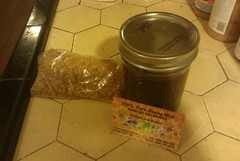
One day, I was driving down East End in south Pomona and I noticed a sign outside someone's home that said HONEY. I immediately made a U-turn to get back to the Honey and was pleasantly surprised.
This part of Pomona is in the unincorporated zone so their Address is officially in Chino (12011 East End Ave.). But the street signs around are still Pomona signs.
View Larger Map
Because they are unincorporated, they can legally have bees and thus are able to harvest honey AND Bee Pollen.
The great thing about Bee Pollen or Bee Bread is that it is the ONLY food that contains ALL 22 Amino Acids. The Bee Pollen that they have is actually the best tasting and cheapest Bee Pollen I've ever had. It is 10 dollars for half a quart sized ziploc bag and 20 for a full bag. I generally have a spoonful first thing in the morning for my protein fix and allergy reducer.
Their honey in comparable to store bought honey in prices but it definitely tastes GREAT, it is VERY Rich and much tastier than Cal Poly's farm store honey. This jar of honey was purchased for 7 dollars. I think it's somewhere between 20 and 25 Fl oz's.
The owners of this bee farm are Rodolfo and Martha. I spoke briefly with them and they have for boxes of bees. The darker honey is from various trees such as avocado and the lighter honey is from clovers and wildflowers.
I suggest going there. There are many health benefits to local honey and local bee pollen, particularly for allergies. And there's a benefit in knowing exactly where your food comes from. The next time I head out there to buy honey or pollen I'll ask them if I can have a tour of their bees and I'll see if I can post some pictures. Support your local economy and buy some honey!
Monday, January 4, 2010
Great Inventions: Mushroom Jerky
Now I've got friends and family who are vegetarians and also either have an aversion to soy or are allergic to soy.
Being a vegetarian means one must give up a lot of foods and not eating soy means one must give up even more.
I've often used mushrooms to replace meat, sometimes using a portobello instead of a patty on my burgers, (though I'm not a vegetarian myself). So this great invention was somewhat of a surprise, but not completely.
Unfortunately, you probably won't find it in your local supermarket, you may not even find it in your local asian market. I found this in a chinese market in Rowland heights called SF supermarket. (on google maps it's called Hong Kong supermarket). I will, however, be keeping an eye out for it at the more local markets.
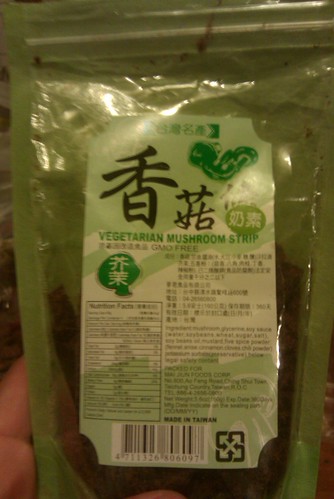
There are 4 different flavors, the green bag is Mustard, and quite delicious. There is also a note on the bag that says GMO FREE, that's always a good sign. Though the ingredients don't state any animal products There is a sticker on each of the bags that says if it has milk or eggs in it. Unfortunately, that sticker is in chinese, so unless you have someone with you that can read chinese, you vegans are SOL. There was one that had no milk or cheese but i don't remember which it was, it was either the red bag or orange. The flavors are also written in chinese so you may be playing a guessing game with that. This particular bag has milk and is the mustard flavor. The only problem is that it is shipped all the way from Taiwan.
While you're there you may want to pick up a bottle of fresh squeezed soy milk over by the butcher(instead of that stuff made from soy flour), something you cannot find in the vicinity of Pomona. The freshest ones are usually pretty warm, almost hot. I must warn you though, if you don't like the taste of soy in your milk, you may not like it.
Sunday, December 27, 2009
Bilingual Typing
I recently converted my keyboard to the following keyboard
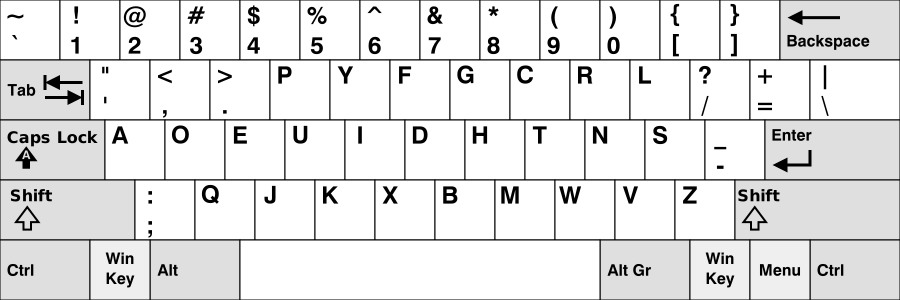
The Dvorak.
It is the only other keyboard recognized by ANSI. Th Dvorak Keyboard was developed as a way to speed up typing and efficiency with typing. If you didn't know, the QWERTY was developed in order to slow down typists. Back in the day when typewriters were in use, typewriters would often jam if a typist would type too fast. Hence, QWERTY.
I began using the Dvorak back in October near the beginning of my quarter in school. For the first few weeks I would switch back to the QWERTY when I had papers longer than 2 pages to write. At some point, I don't remember when, I stopped switching back, even for long 15 page papers. That was probably only four weeks into using tho keyboard. One thing I can say, is that i can definitely feel a difference in typing. At work where I use a QWERTY my fingers fly all over my keyboard, but at home my fingers barely move, and at first it felt VERY strange.
I decided to make the switch, even though it created challenges at first because it is a technelegical advancement, that is appropriate for computing and is much more efficient. Appropriate technology and efficiency, if you haven't noticed, are two (of many) things that I try to live by.
The Dvorak.
It is the only other keyboard recognized by ANSI. Th Dvorak Keyboard was developed as a way to speed up typing and efficiency with typing. If you didn't know, the QWERTY was developed in order to slow down typists. Back in the day when typewriters were in use, typewriters would often jam if a typist would type too fast. Hence, QWERTY.
I began using the Dvorak back in October near the beginning of my quarter in school. For the first few weeks I would switch back to the QWERTY when I had papers longer than 2 pages to write. At some point, I don't remember when, I stopped switching back, even for long 15 page papers. That was probably only four weeks into using tho keyboard. One thing I can say, is that i can definitely feel a difference in typing. At work where I use a QWERTY my fingers fly all over my keyboard, but at home my fingers barely move, and at first it felt VERY strange.
I decided to make the switch, even though it created challenges at first because it is a technelegical advancement, that is appropriate for computing and is much more efficient. Appropriate technology and efficiency, if you haven't noticed, are two (of many) things that I try to live by.
Saturday, December 19, 2009
Pomona Massacre of Dec. 11th 2009

On December 11th in the still of the night, masked bandits made their way into my yard and opened the door to my chicken coop.
Unfortunately I was partly at fault. It was the night that i did not make sure the coop door had latched.
When I woke up in the morning I found that only one of my fifteen chickens and ducks were left alive. It was the sole rooster.
Raccoons massacred all but one of my birds overnight.
Raccoons are jerks. Let me tell you why; they did not eat most of the birds, in fact only one and a half were actually eaten. most of the rest were just killed, many of them with their heads severed.
I have already set a preliminary fence around the coop so that it will be harder for the raccoons to get to them and so that I can let my dog out to protect the birds. (i've successfully gotten our dog Nova to stop chasing chickens thanks to a dog whisperer episode) I will also be setting some humane traps for these bastards and will be sending them to the mountains.
Let this be a lesson, if there are critters in your yard call vector control services and also if you've got birds, keep them safe at night!
p.s. i would share pictures but it's pretty disturbing.
Saturday, December 12, 2009
Back with a Hobbit Story
Hi All, I've been out for some time since Grad school Started. you can imagine why. It's VERY time consuming. But I've been up to a LOT. Really, I've been putting my money where my mouth is.
so in November a classmate of mine Kim P. and myself designed and built a test cell for thermal comfort. We also had help from my classmates Jacob, James, Melissa, and Alexandra. yau can go see it for yourself at the Center for Regenerative Studies at Cal Poly Pomona.

Essentially it is a hobbit hole with a large door facing south. We open up the door during the day and let in some sun that heats up stone tiles on the floor. We had initially been closing the door at around 3 pm but after we pulled the data we discovered it'd be best to shut the door no later than 1pm. I talk about why building underground is beneficial in a previous post.

The blue line is the temperature range inside the house and the red line is the temperature range outside. The yellow bar is the typical temperature range for thermal comfort. As you can see it did ok, but next time we should close the door at the peak of it's temperature gain. The lowest it got outside is just below 35 degrees and the lowest it got inside is just under 60 degrees while the warmest it got outside is just over 60 degrees but inside it got up to just over 85 degrees. This is all with passive methods and no energy usage.
When it's hotter in the summer we'll probably just need to keep the door closed and it'll stay cool all day.
Here's the opening line to The Hobbit
"In a hole in the ground there lived a hobbit. Not a nasty, dirty, wet hole, filled with the ends of worms and an oozy smell, nor yet a dry, bare, sandy hole with nothing in it to sit down on or to eat: it was a hobbit-hole, and that means comfort." - Tolkien
so in November a classmate of mine Kim P. and myself designed and built a test cell for thermal comfort. We also had help from my classmates Jacob, James, Melissa, and Alexandra. yau can go see it for yourself at the Center for Regenerative Studies at Cal Poly Pomona.

Essentially it is a hobbit hole with a large door facing south. We open up the door during the day and let in some sun that heats up stone tiles on the floor. We had initially been closing the door at around 3 pm but after we pulled the data we discovered it'd be best to shut the door no later than 1pm. I talk about why building underground is beneficial in a previous post.

The blue line is the temperature range inside the house and the red line is the temperature range outside. The yellow bar is the typical temperature range for thermal comfort. As you can see it did ok, but next time we should close the door at the peak of it's temperature gain. The lowest it got outside is just below 35 degrees and the lowest it got inside is just under 60 degrees while the warmest it got outside is just over 60 degrees but inside it got up to just over 85 degrees. This is all with passive methods and no energy usage.
When it's hotter in the summer we'll probably just need to keep the door closed and it'll stay cool all day.
Here's the opening line to The Hobbit
"In a hole in the ground there lived a hobbit. Not a nasty, dirty, wet hole, filled with the ends of worms and an oozy smell, nor yet a dry, bare, sandy hole with nothing in it to sit down on or to eat: it was a hobbit-hole, and that means comfort." - Tolkien
Friday, October 16, 2009
Just won an award for these.

So I'm adding a creative commons license so no one makes money off of them

Finished product.

Tire Chair by Andrew Kanzler is licensed under a Creative Commons Attribution-Noncommercial-Share Alike 3.0 United States License.
Sunday, August 30, 2009
Just got back from Peru,
I forgot to post that I was leaving for a couple weeks to Peru. I went with Green Empowerment to provide assist with water problems in rural communities of the andes. I'll have to fill you all in about it once I've finished catching up on things to do around the house.
Friday, July 17, 2009
More Community Action! Through the Weekend and Wednesday at DBA 256

So all through this weekend there will be more work parties to help out Dawn of the Garden and Pam of the Yarn Shop.
ALSO! I'm looking forward to this. There will be a fundraising event at DBA 256, drinking beer and wine for a cause? Sounds good to me!
Sunday, July 12, 2009
The First Organic Garden Shop in LA "The Garden" in Pomona Burned Down Yesterday
click here for more info at M-M-M-My Pomona
there are updates from community members there as well and links to News coverage.
The owner is Dawn Van Allen, she is also a regular on the workshop and lecture circuit for urban gardening among other things
The Yarn Shop next door also burned down.
These two businesses are well known among the community, in fact The Garden is the only place that Lisa ever frequents, and those that know us, know that Lisa almost never leaves the house, especially during the day.
there are updates from community members there as well and links to News coverage.
The owner is Dawn Van Allen, she is also a regular on the workshop and lecture circuit for urban gardening among other things
The Yarn Shop next door also burned down.
These two businesses are well known among the community, in fact The Garden is the only place that Lisa ever frequents, and those that know us, know that Lisa almost never leaves the house, especially during the day.
Wednesday, July 8, 2009
Bicycling: The New Golf?
In New York (and Provo, and San Diego, and San Francisco) they are saying that Bicycling is the new golf. I'm not quite sure about that, and I don't think bicycling could adequately replace golf. I'm not a golfer, I've been golfing a handful of times, but I do think there are some fundamental differences that won't allow for one to replace the other. I do however agree that bicycling is picking up in popularity while golfing is declining, but it's not quite the same. So I've made a few comparisons (without addressing much in the article which talks more about the social aspects of golfing and networking):

Outdoors: Both "sports" happen outdoors, one in a very specific place that I find to be redundant and also not very conducive to the diversity of the environment. The other can happen almost anyplace at anytime.

Danger: Cycling is much more dangerous you cold get hit by a car! Though golfing DOES have its dangers.

Shoes: You can really golf or bicycle in almost any time of shoe. However, serious golfers and serious cyclists both have their own versions of cleats.

Clothing: I probably will not be wearing lycra anytime soon. Look at that style on those golfers though, I love it. Knickers also make perfect sense for bicycles. They'll keep your pants out of the chain instead of having to roll up your pant leg.

Folks early on seemed to recognize that golf clothing would work great for cycling. But somewhere along the development of bicycle clothing, clothes became geared only towards those who love spandex.

Fortunately, it looks like there are some folks who hate lycra as much as I do. This looks like a viable option, but i think there's still a ways to go.

Skill: Both Cycling and Golfing take adequate training. I know there are some people who teach their kids how to golf early on in their lives, but I still don't think it's as common as being taught how to ride a bike as a kid. One can learn how to bike in a day, it's much harder to learn how to golf in a day.

Transport: As we can see in this exhibit, it takes a bicycle in order to bicycle, and in order to golf one either needs to walk or use a golf cart. ALSO in order to GO golfing one needs to drive to the golf course with clubs in hand. In order to bicycle one just needs to jump on a bicycle. So you inevitably are being environmentally friendly, and with being environmentally friendly you are going to save money.
Here's a great article from Health & Fitness It talks about some more differences from golf and cycling. Things like Health benefits, Family time, Cost etc...
So is bicycling the new golf? I think it can be a viable way for execs to network over golfing, I think it's a better "sport" than golfing is by far. If I want to play a game that puts balls in holes I'll go play pool down on second street, (that guy really takes care of his tables AND cues they're PERFECT) and I'll bicycle there.
Bicycling is the new golf in that it is taking the place of many social aspects of golf while the popularity of the sport declines and while cycling ascends. But cycling will never take the place of the type of sport that golf is (for old white and asian men, which I will be one day except not plural)

Outdoors: Both "sports" happen outdoors, one in a very specific place that I find to be redundant and also not very conducive to the diversity of the environment. The other can happen almost anyplace at anytime.

Danger: Cycling is much more dangerous you cold get hit by a car! Though golfing DOES have its dangers.

Shoes: You can really golf or bicycle in almost any time of shoe. However, serious golfers and serious cyclists both have their own versions of cleats.

Clothing: I probably will not be wearing lycra anytime soon. Look at that style on those golfers though, I love it. Knickers also make perfect sense for bicycles. They'll keep your pants out of the chain instead of having to roll up your pant leg.

Folks early on seemed to recognize that golf clothing would work great for cycling. But somewhere along the development of bicycle clothing, clothes became geared only towards those who love spandex.

Fortunately, it looks like there are some folks who hate lycra as much as I do. This looks like a viable option, but i think there's still a ways to go.

Skill: Both Cycling and Golfing take adequate training. I know there are some people who teach their kids how to golf early on in their lives, but I still don't think it's as common as being taught how to ride a bike as a kid. One can learn how to bike in a day, it's much harder to learn how to golf in a day.

Transport: As we can see in this exhibit, it takes a bicycle in order to bicycle, and in order to golf one either needs to walk or use a golf cart. ALSO in order to GO golfing one needs to drive to the golf course with clubs in hand. In order to bicycle one just needs to jump on a bicycle. So you inevitably are being environmentally friendly, and with being environmentally friendly you are going to save money.
Here's a great article from Health & Fitness It talks about some more differences from golf and cycling. Things like Health benefits, Family time, Cost etc...
So is bicycling the new golf? I think it can be a viable way for execs to network over golfing, I think it's a better "sport" than golfing is by far. If I want to play a game that puts balls in holes I'll go play pool down on second street, (that guy really takes care of his tables AND cues they're PERFECT) and I'll bicycle there.
Bicycling is the new golf in that it is taking the place of many social aspects of golf while the popularity of the sport declines and while cycling ascends. But cycling will never take the place of the type of sport that golf is (for old white and asian men, which I will be one day except not plural)
Saturday, July 4, 2009
Bee Orgy

Found this in my yard today in one of the flowers on a squash vine. Thought I'd share it with you all.
Thursday, July 2, 2009
Future of Housing: Living Underground?
The ninja turtles did it, why can't we?
I've often wondered about the direction in which home building is going. "What will homes look like in the future?" And I always come to the same conclusion. Homes of the future are all going to be "underground" in one way or another. I put it in quotes, because the definition of "underground" in the way i speak of it can be disupted.
If we look back at the history of homes the first shelters were caves. It seems like a caricature of the cave person, but there is much evidence that points to caves being used as the earliest shelters by humans. See Lascaux. I'm also sure that trees were used as shelters, soon afterwards, sticks from the trees to prop an overhead structure up, then huts made of sticks and wood, and eventually that evolved into the modern day house.
I believe if the technology were available much earlier in our human history, we would probably be living in man made caves and underground. But it didn't and so instead, we are coming up with buildings with green roofs and living walls.


Windows. it seems silly, but that seems to be the most important distinction. When thinking of a cave, one typically imagines a dark, often damp, hard and sometimes scary place. Buildings instead, (particularly homes) are well lit, have windows to see outside and let in sun, are dry and very warm and comforting. With what is possible now and all the achievements made in engineering, living underground can be just as comforting, warm, well lit, and dry as living above ground.
Living underground is environmentally friendly on very many levels. More and more buildings today are taking advantage of the consistent 58 degrees Fahrenheit of being underground. Here in Pomona, the Center for Regenerative Studies has a building built into a hillside. This design takes advantage of the earth's natural insulation. Other buildings like that are popping up all over the place. Having a green roof also provides opportunities to grow food, and/or a place for wildlife to visit. The California Academy of Sciences building in San Fran does exactly that, it is planted with vegetation found specifically in the area where the building was placed. The Center for Regenerative studies also has a study building with a green roof that has some food plants growing on it. The same can be done with living walls.
When I own land, I'm going to build my home underground. And I mean literally underground, I'll likely be living in Pomona and since our water table is relatively high it'll look like a mound. It will have solar light tubes to let light into the home and I'll be growing fruits and vegetables all over it. Maybe it'll end up looking like Bilbo Baggins house from The Hobbit.

I've often wondered about the direction in which home building is going. "What will homes look like in the future?" And I always come to the same conclusion. Homes of the future are all going to be "underground" in one way or another. I put it in quotes, because the definition of "underground" in the way i speak of it can be disupted.
If we look back at the history of homes the first shelters were caves. It seems like a caricature of the cave person, but there is much evidence that points to caves being used as the earliest shelters by humans. See Lascaux. I'm also sure that trees were used as shelters, soon afterwards, sticks from the trees to prop an overhead structure up, then huts made of sticks and wood, and eventually that evolved into the modern day house.
I believe if the technology were available much earlier in our human history, we would probably be living in man made caves and underground. But it didn't and so instead, we are coming up with buildings with green roofs and living walls.

Windows. it seems silly, but that seems to be the most important distinction. When thinking of a cave, one typically imagines a dark, often damp, hard and sometimes scary place. Buildings instead, (particularly homes) are well lit, have windows to see outside and let in sun, are dry and very warm and comforting. With what is possible now and all the achievements made in engineering, living underground can be just as comforting, warm, well lit, and dry as living above ground.
Living underground is environmentally friendly on very many levels. More and more buildings today are taking advantage of the consistent 58 degrees Fahrenheit of being underground. Here in Pomona, the Center for Regenerative Studies has a building built into a hillside. This design takes advantage of the earth's natural insulation. Other buildings like that are popping up all over the place. Having a green roof also provides opportunities to grow food, and/or a place for wildlife to visit. The California Academy of Sciences building in San Fran does exactly that, it is planted with vegetation found specifically in the area where the building was placed. The Center for Regenerative studies also has a study building with a green roof that has some food plants growing on it. The same can be done with living walls.
When I own land, I'm going to build my home underground. And I mean literally underground, I'll likely be living in Pomona and since our water table is relatively high it'll look like a mound. It will have solar light tubes to let light into the home and I'll be growing fruits and vegetables all over it. Maybe it'll end up looking like Bilbo Baggins house from The Hobbit.
Tuesday, June 30, 2009
Forgotten Fruits: Mangosteen (Garcinia mangostana)

Ah, the mangosteen, the sweet sweet mangosteen (no relation to the mango). The Queen of fruits. This fruit is described as sweet and tangy, citrusy with peach flavor and texture. I've had it (canned), it's pretty delicious and definitely different. You can obtain canned mangosteen at many asian supermarkets nearby. It may even be possible to find fresh mangosteen in some asian markets but i've never seen it. In New York fresh fruits have gone for $45 a pound in some produce stores. It is very rare to find fresh mangosteen. So if you can ever get your hands on it, try it!.
Until recently it was completely unavailable in the States. It is a very tropical fruit and there were many restrictions on fruit imports from southeast asia where the mangosteen is native to. In 2006 Puerto Rico began sending mangosteen to some specialty food places in the US and in 2007 the ban on fruits without special preparation was removed allowing mangosteen and all its forms to be allowed into the states.
There is a legend that says that Queen Victoria had offered a reward to anyone that could bring the fruit back to her as the fruit itself had many legends behind it.
Because it is ultra tropical, it is nearly impossible to grow in the states. In it's native home, the tree can grow from 25 to 80 feet tall. What can be done though is to grow it in a greenhouse in Southern California. The mangosteen will surely die if it even spends a single night anywhere below 40 degrees F. Here in Pomona it's common to see nights down in the 30's in the winter. But with a green house some good design using passive radiant heating techniques could probably solve this problem.

There are also other types of mangosteen. The most popular is the purple mangosteen but there is also the lemon mangosteen, which is more citrusy in flavor and almost looks like a lemon (it's yellow) and also the button mangosteen. The lemon mangosteen is from South America instead of from asia and is described as a lemony cotton candy. The button mangosteen is described as having an almost tangerine like flavor. There are actually more types of mangosteens but it's hard to find much information on them. These two mangosteens can survive in temperatures down to 35 degrees, so i'll grow them in containers and at nights i'll bring them inside in the winter.
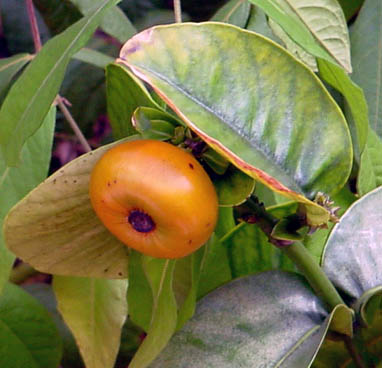
I have very young plants of both the lemon mangosteen and button mangosteen. I'm being very careful with these two as I've already accidently killed my jackfruit due to over watering. The button mangosteen is doing well, but the lemon mangosteen is going much slower, and I accidently burned part of one leaf. I'll need to make a small greenhouse out of the plastic bottles i've been collecting.
Subscribe to:
Posts (Atom)

 Posts
Posts


